What Makes a "Dream School" Dreamy?
“What do you think about Columbia for my child?” the mom of a high school senior asked me this fall. I’d coached the student through college essays during the summer, so I knew them both by this point. “Are their SAT scores too low?” the mom added, as if this were the sole barrier to entry. As the student’s private admissions counselor, I tried my best to explain that her child’s SAT scores weren’t the only – or even the most significant – factor making Columbia a bad fit for this shy student.
private admissions counselor gets personal
I noted that her child required a good deal of support and direction during the application process. Columbia students, on the other hand, tend to be highly self-directed. I recounted that my own time as an undergraduate at Harvard was often unhappy – even though I thrived academically. A dolphin, I could survive among sharks, but that didn’t mean I liked it. Yet Harvard’s prestige was too much for someone like me – a first-generation, low-income student – to pass up.
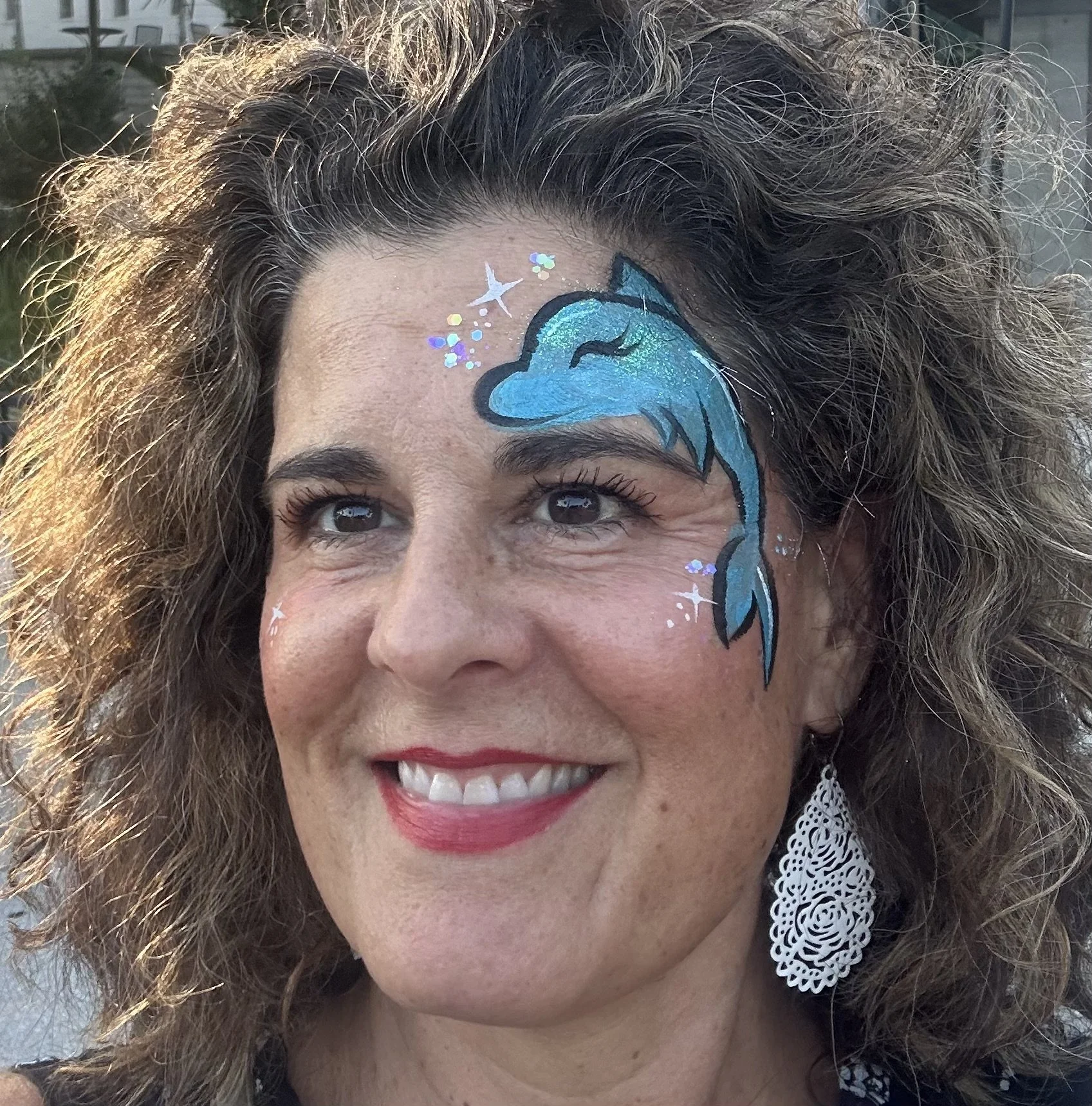
Image by Dominique Padurano
What did I gain by “sucking it up” for four years? A great education and an even greater credential, no doubt. Both have blossomed into opportunities that have enriched my life. But what did I lose by choosing (and choosing to stay at) Harvard? In short: supportive mentors and a close-knit peer network. I skipped office hours because I was too intimidated by my professors, who weren’t incentivized by the university to cultivate undergrads. And while I made friends, of course, none became the lifelong supports that I’ve wished for.
Had I been another person in 1989, Harvard could have provided me with what I needed. But that’s the point: I was who I was, and Harvard simply wasn’t the right fit for me at that time. (Had I had a private admissions counselor, I might have made a different choice.) As a result, I missed out on the two most important characteristics of a “successful” college education: the development of a strong mentor and peer relationships. These bonds do not just promote students’ well-being at college. They set students up for lifelong professional, financial, and psychosocial success.

Image by @sliverkblack on Unsplash
Private admissions counselor’s advice
As a private admissions counselor, I share my mini biography often to illustrate how important “fit” is when building a balanced college list. Most private admissions counselors will concede that we need to re-orient families’ definitions of what a “good” college is. We also need to redefine what “success” looks like.
While this mission isn’t impossible, it does take time and multiple conversations. To initiate this dialogue, my classmate Wendy Chang and I invite you to join us for an open-ended discussion of college admissions today. Inspired by Jeffrey Selingo’s Dream School: Finding the College That’s Right For You, the discussion will occur over Zoom onFebruary 1, 2026, at 6pm. This evening will not be a lecture. Instead, we’ll be asking attendees to consider:
· How has the definition of “a good college” changed since we applied?
· What does “fit” actually mean in your family?
· How do we balance emotional, educational, and financial considerations?
· What would success look like if no one else could see the outcome?
· If college is about becoming an adult, what kind of adult are you hoping your child becomes?
· What feels risky about the current process — and what risks might actually be healthy for your child’s development?
While Selingo explores these questions in his new bestseller, you do not need to have read his book to attend or participate. (However, if you want to read just the first pages, you can do so for free here.). And you don’t need a degree in private admissions counseling to provide answers to these questions. But they (and the other questions we’ll be diving into) are worth pondering as or before you enter the college application process. As a private admissions counselor, I’m hoping that the evening’s conversation will inspire, educate, and calm you as you embark upon one of the most exciting journeys that you and your child will share!
Registration is free and open to the public. While we’ll gear the conversation primarily toward parents, we’re happy to welcome students, their grandparents (and any loved one playing a part in their college journey), other private admissions counselors and aligned educators.
If you know someone who might benefit from the discussion, please share the registration link with them. You can also share directly to Facebook, LinkedIn, X, or email using the gray social media icons on the right side of the registration page. We’d love for this discussion to help as many families as possible!
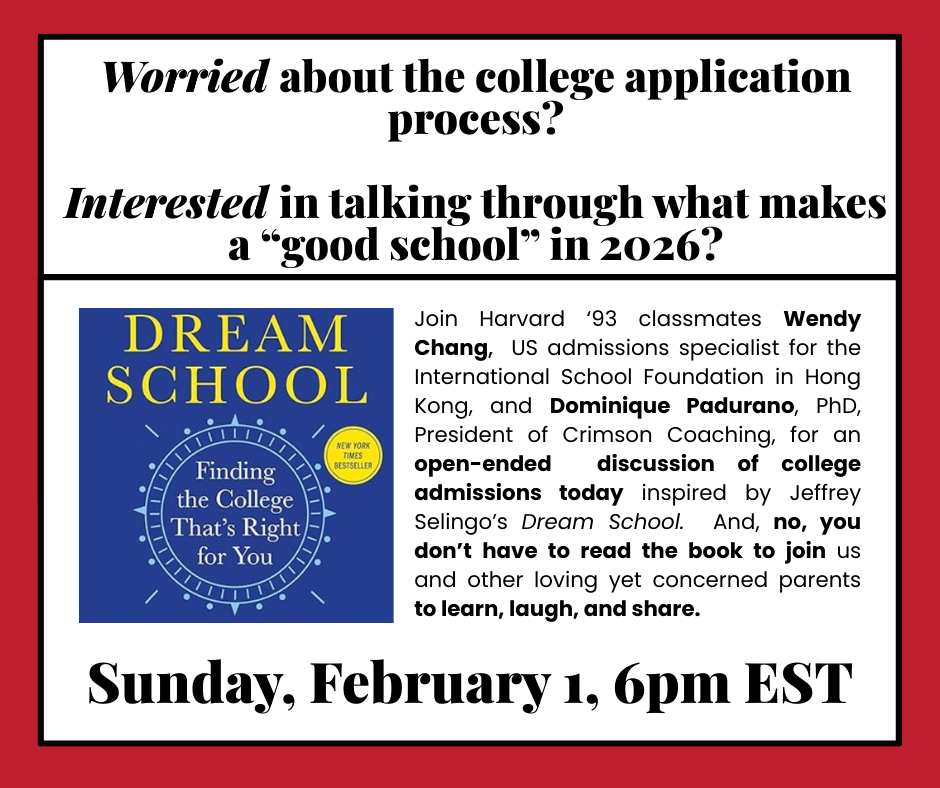
Image by Dominique Padurano
Final Words of Advice from This Private Admissions Counselor
In today’s competitive economic landscape, it’s easy to grasp at brand names as a bulwark against uncertainty. As admission to brand-name universities becomes increasingly unlikely, though, it’s important to consider alternatives. As we’ll discuss on February 1, attending colleges that prioritize strong student-faculty bonds, student well-being, and pre-professional opportunities might just be that bulwark you’ve been looking for!
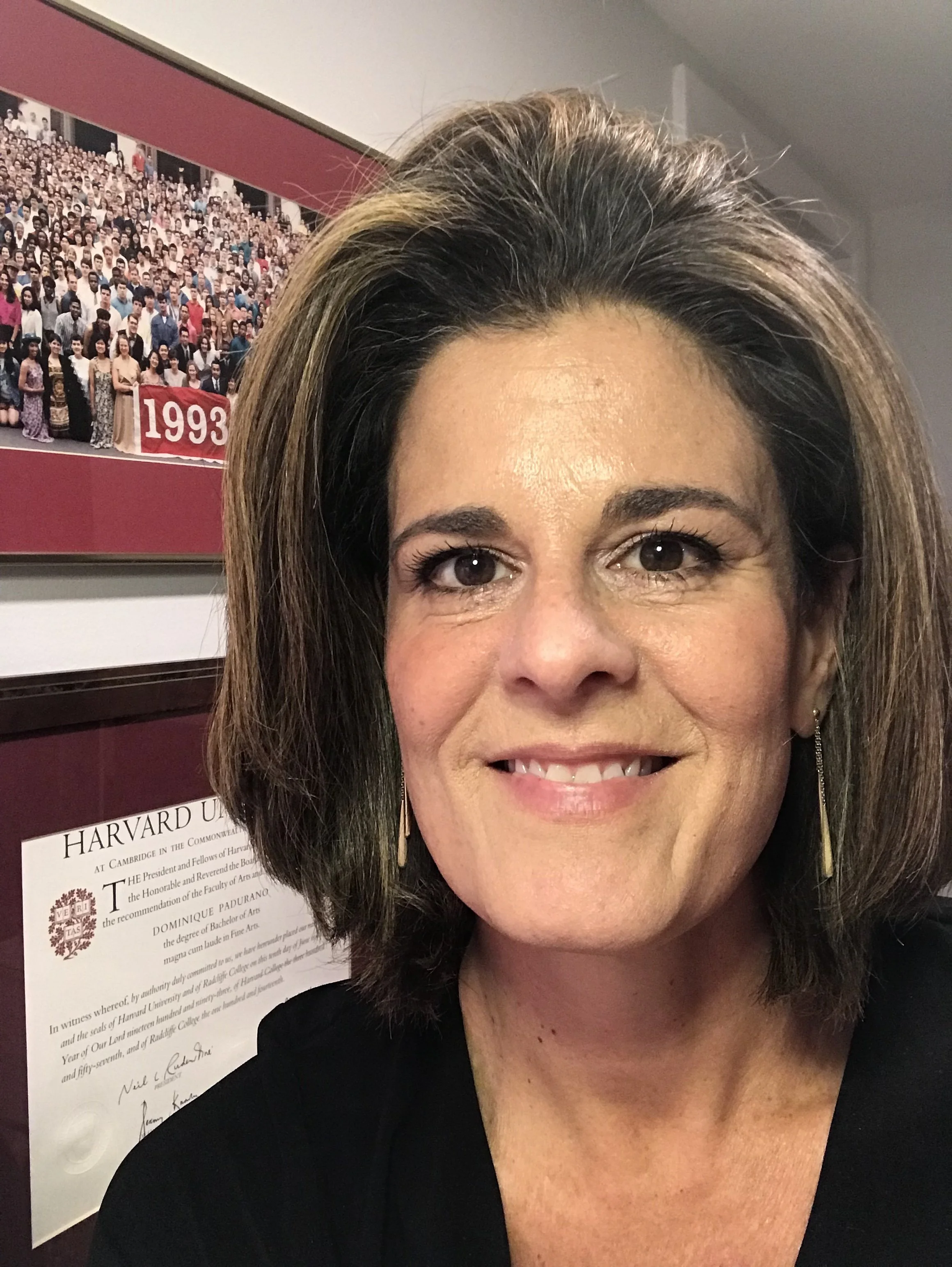
Image by Dominique Padurano
About the Author
Dominique Padurano, M.S., Ed., Ph.D. – aka “Dr. P.” – loves helping students across the globe fulfill their academic and personal goals. President and Founder of Crimson Coaching, Dr. P. herself personally tutorsstudents in English, French, History, Math, Spanish, and study, time management, and organizational skills; prepares them for the SAT, ACT, GRE, ISEE, AP, and other exams as a test prep coach; and shepherds them through the college application process as a private college counselor and essay coach. Dr. P.’s students have earned admission to Harvard (her own alma mater), Princeton, Stanford, and other top universities, as well as scholarships – including full rides – totaling more than $2 million. Formerly an adjunct professor of U.S. History at the City University of New York, Dr. P. now teaches Historical Studies online for the State University of New York – Empire State. Read more about Dr. P.’s work at www.crimsoncoaching.com and on Google, straight from the hearts and minds of Crimson Coaching’s parents and students.